The Human Body: Structure, Functions, and Amazing Facts
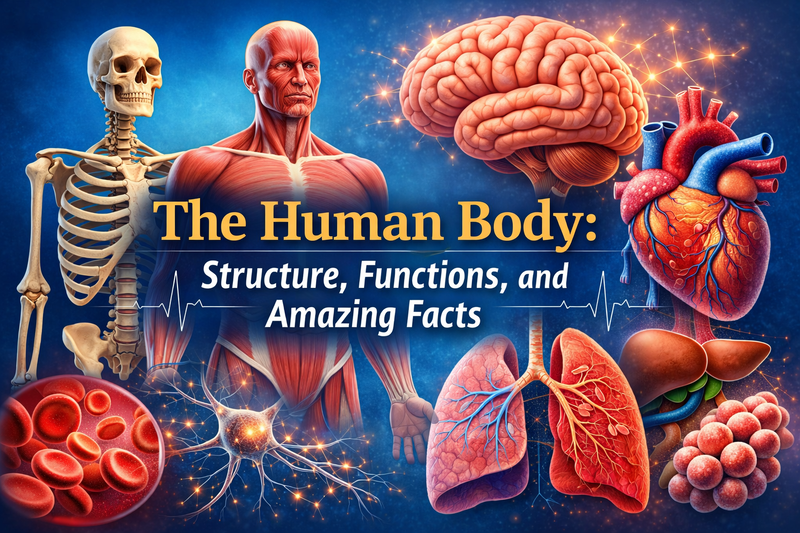
The Human Body: Structure, Functions, and Amazing Facts
The human body is one of the most complex and extraordinary creations in the natural world. Every day we walk, talk, think, breathe, and feel without consciously realizing the incredible biological systems working behind the scenes. Trillions of cells coordinate perfectly to keep us alive and functioning. From the beating of the heart to the firing of neurons in the brain, the human body operates like a highly advanced machine.
In this article, we will explore the structure of the human body, its major organ systems, how they function, and why maintaining good health is essential for overall well-being.
1. Basic Structure of the Human Body
The smallest unit of the human body is the cell. An adult human body contains approximately 37 trillion cells. Cells combine to form tissues, tissues form organs, and organs work together in organ systems.
There are four main types of tissues in the human body:
Epithelial tissue – Covers and protects surfaces (such as skin).
Connective tissue – Supports and binds structures (such as bone and blood).
Muscle tissue – Enables movement.
Nervous tissue – Transmits signals throughout the body.
This hierarchical organization allows the body to function efficiently and maintain balance, also known as homeostasis.
2. Skeletal System
The skeletal system forms the structural framework of the body. An adult human has 206 bones. These bones provide shape, protect internal organs, and enable movement.
Main functions of the skeletal system:
Support and structure
Protection of vital organs
Blood cell production (in bone marrow)
Storage of minerals like calcium
For example, the skull protects the brain, the rib cage protects the heart and lungs, and the vertebral column supports the body and protects the spinal cord.
3. Muscular System
The muscular system allows the body to move. There are over 600 muscles in the human body. Muscles work by contracting and relaxing.
There are three types of muscle tissue:
Skeletal muscle – Voluntary movement (walking, lifting).
Smooth muscle – Involuntary movement (digestion, blood vessel control).
Cardiac muscle – Found only in the heart.
Without muscles, even simple actions like smiling or blinking would not be possible.
4. Nervous System
The nervous system is the body’s control center. It is divided into:
Central nervous system (CNS) – Brain and spinal cord
Peripheral nervous system (PNS) – Nerves throughout the body
The brain controls thought, memory, emotion, and movement. The spinal cord acts as a communication highway between the brain and the rest of the body.
The basic unit of the nervous system is the neuron, which transmits electrical signals rapidly throughout the body.
5. Circulatory System
The circulatory system delivers oxygen and nutrients to every cell in the body. The heart is its central organ. It beats about 100,000 times per day, pumping blood continuously.
Blood consists of:
Red blood cells – Carry oxygen
White blood cells – Fight infections
Platelets – Help blood clot
Arteries carry blood away from the heart, veins return it, and capillaries connect the two.
6. Respiratory System
The respiratory system allows us to breathe. Its main function is to take in oxygen and remove carbon dioxide.
Air enters through the nose or mouth, travels down the trachea, and reaches the lungs. Inside the lungs are tiny air sacs called alveoli, where oxygen enters the bloodstream.
The diaphragm, a dome-shaped muscle below the lungs, helps control breathing.
7. Digestive System
The digestive system breaks down food into nutrients that the body can absorb.
It begins in the mouth and continues through the esophagus, stomach, small intestine, large intestine, and rectum.
The stomach breaks down food with acids.
The small intestine absorbs nutrients.
The large intestine absorbs water.
The liver and pancreas produce important digestive substances.
Proper digestion is essential for energy and growth.
8. Urinary System
The urinary system removes waste products from the blood and maintains fluid balance.
The kidneys filter the blood and produce urine. This process helps eliminate toxins and regulate salt and water levels in the body.
9. Endocrine System
The endocrine system produces hormones that regulate many body processes, including growth, metabolism, mood, and sleep.
Important glands include:
Pituitary gland
Thyroid gland
Adrenal glands
Pancreas
Hormones act as chemical messengers that travel through the bloodstream to target organs.
10. Immune System
The immune system protects the body from harmful microorganisms such as bacteria and viruses.
White blood cells, antibodies, and lymph nodes work together to identify and destroy invaders. A strong immune system helps prevent illness and promotes faster recovery.
11. Amazing Facts About the Human Body
The heart pumps millions of liters of blood during a lifetime.
The brain uses about 20 watts of power.
Around 60% of the human body is made of water.
The skin is the largest organ.
Millions of cells die and are replaced every day.
12. How to Keep the Human Body Healthy
Maintaining good health is essential for a long and active life. Here are some important habits:
Eat a balanced diet
Exercise regularly
Get enough sleep
Drink plenty of water
Manage stress
Avoid harmful substances
Healthy lifestyle choices improve both physical and mental well-being.
Conclusion
The human body is an extraordinary and highly organized system. Each organ and system plays a vital role in keeping us alive and functioning. From the skeletal structure that supports us to the nervous system that controls our thoughts and movements, every part works in harmony.
Understanding the human body not only increases our appreciation of its complexity but also encourages us to take better care of our health. The more we learn about our bodies, the more we realize how remarkable they truly are.
Comments
No comments yet. Be the first to comment!